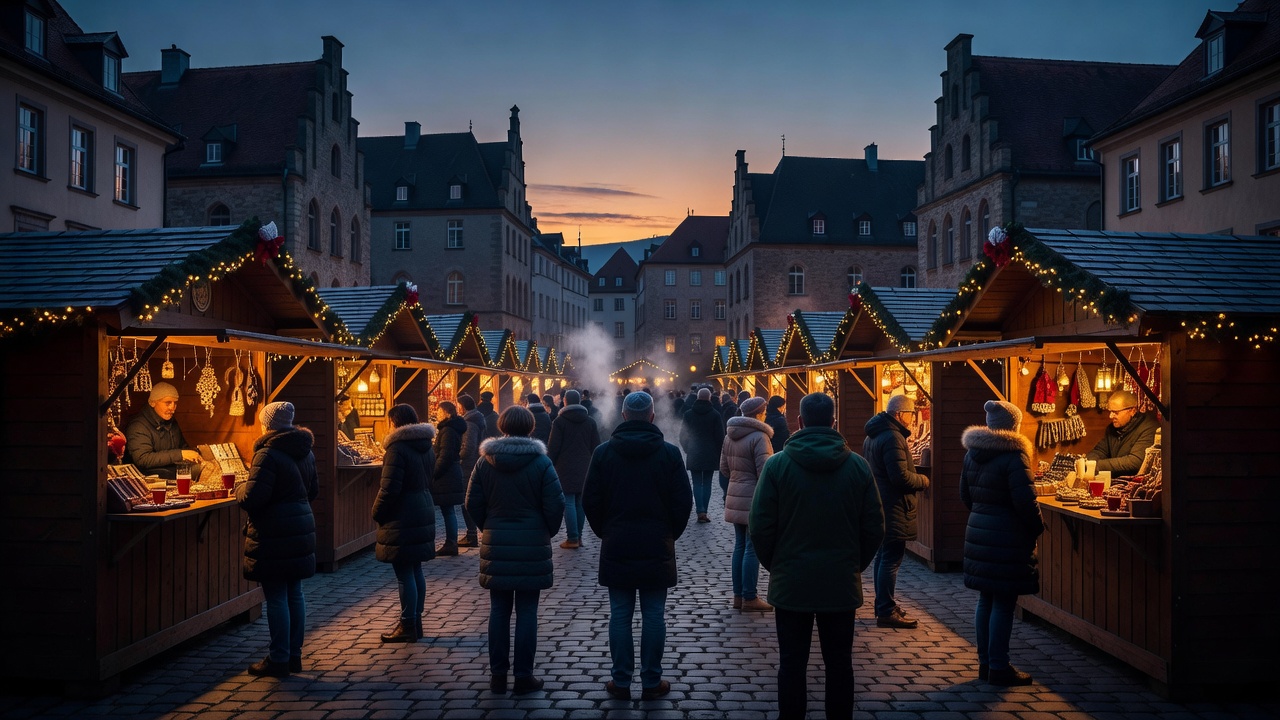
Market squares from Salzburg to Colmar
Advent markets along a rail line that runs from Austria into Alsace, with notes on dates, daylight and the trains between them.
The rhythm of an Alpine Advent
In the German-speaking Alps and along the Rhine, the Christmas market season follows Advent rather than a fixed date. Most of the well-known markets open in the second half of November, often on or just before the weekend of the first Sunday of Advent, and the traditional ones close on 24 December, when families go home for Christmas Eve. A smaller number stay open, or reopen in a different form, until New Year. If you picture a winter break in the week between Christmas and New Year, check each town carefully, because the market you imagine may already have been taken down.
The calendar inside the season matters too. 6 December is Saint Nicholas Day across much of the region. In Austria and Bavaria the days around it bring Krampus runs, where costumed figures in carved wooden masks and heavy bells parade through the streets. They are loud and deliberately frightening. Some children love them and some do not, so parents may want to watch from the edge of the crowd the first time.
Weekends are crowded nearly everywhere. A Tuesday or Wednesday evening at the same market feels like a different place: you can reach the stalls, hear the brass band and find a spot at a standing table without queuing for it.
Salzburg: a baroque square and a carol's birthplace
Salzburg's Christkindlmarkt fills Domplatz and Residenzplatz in front of the cathedral with wooden stalls selling glass ornaments, carved figures, roasted almonds and mulled wine. The old town is compact enough to cross on foot in twenty minutes, and the Hohensalzburg fortress above it is lit after dark, which in December means from around half past four. Smaller markets are scattered around the city, including one in the grounds of Hellbrunn Palace on the southern edge.
About twenty kilometres north, the village of Oberndorf is where "Stille Nacht" ("Silent Night") was first performed on Christmas Eve 1818, by the priest Joseph Mohr and the teacher and organist Franz Xaver Gruber. The original church is gone, but a small memorial chapel stands near the site and is the focus of a short open-air commemoration on 24 December. The Salzburger Lokalbahn, a local line leaving from Salzburg's main station, reaches Oberndorf in well under an hour.
Salzburg Hauptbahnhof sits on the main line between Vienna and Munich, with frequent fast services in both directions. Near the solstice the city gets a little over eight hours between sunrise and sunset, and in the narrower valleys around it the mountains shorten direct sunlight further.
Innsbruck and the Inn valley
Innsbruck places its main market in the old town below the Goldenes Dachl, the gilded late-Gothic balcony built for Emperor Maximilian I around 1500. Other markets spread to Marktplatz beside the river and up to the Hungerburg plateau, reached by the Hungerburgbahn funicular from the city centre. The Nordkette cable cars continue higher, so on a clear day it is possible to browse a market in the morning and stand in deep snow above the city by midday.
Innsbruck is a stop on the Railjet line that links Vienna and Salzburg with Zürich. The section west through the Arlberg runs close to snow-covered slopes and is one of the more scenic winter rail rides in Europe. In heavy snowfall, though, expect the occasional delay on mountain sections.
Nuremberg, a detour north
Strictly speaking Nuremberg is in Franconia, not the Alps, but it is a short ride from Munich on the high-speed line, and its Christkindlesmarkt is one of the best known in Germany. The market opens on the Friday before the first Sunday of Advent, when the Christkind, a young person chosen to wear a gold crown and white robes, reads a prologue from the balcony of the Frauenkirche above the Hauptmarkt. Expect Lebkuchen, the city's spiced gingerbread, and small Nuremberg sausages served three in a bread roll, known locally as "Drei im Weggla". A separate children's market sits close to the main one, with a carousel and craft stalls.
Gengenbach and the Black Forest
Heading west toward the Rhine, the small town of Gengenbach in the Kinzig valley turns the windows of its town hall façade into an Advent calendar, revealing a new illustrated window each evening in December. It is a modest sight compared with the big cities, and that is its appeal: a short walk, a market in the old town, and a quiet train back. Gengenbach lies on the Black Forest Railway from Offenburg, a regional line that climbs through tunnels and loops toward Lake Constance.
Strasbourg and Colmar
Across the border in Alsace, Strasbourg's Christkindelsmärik traces its history to 1570, which makes it one of the oldest Christmas markets in France. Today it spreads over many squares around the cathedral, with a very large tree on Place Kléber. Security checks at the bridges into the island old town are normal in December, so allow extra time at peak hours.
Colmar, about half an hour south by regional TER train, runs several smaller markets through its old centre, including near the canals of the Petite Venise quarter. The half-timbered houses, low light and reflections on the water are why many visitors find Colmar the more photogenic of the two. Nearby villages such as Kaysersberg and Riquewihr hold their own markets and can be reached by local bus, though services are thinner on Sundays and holidays.
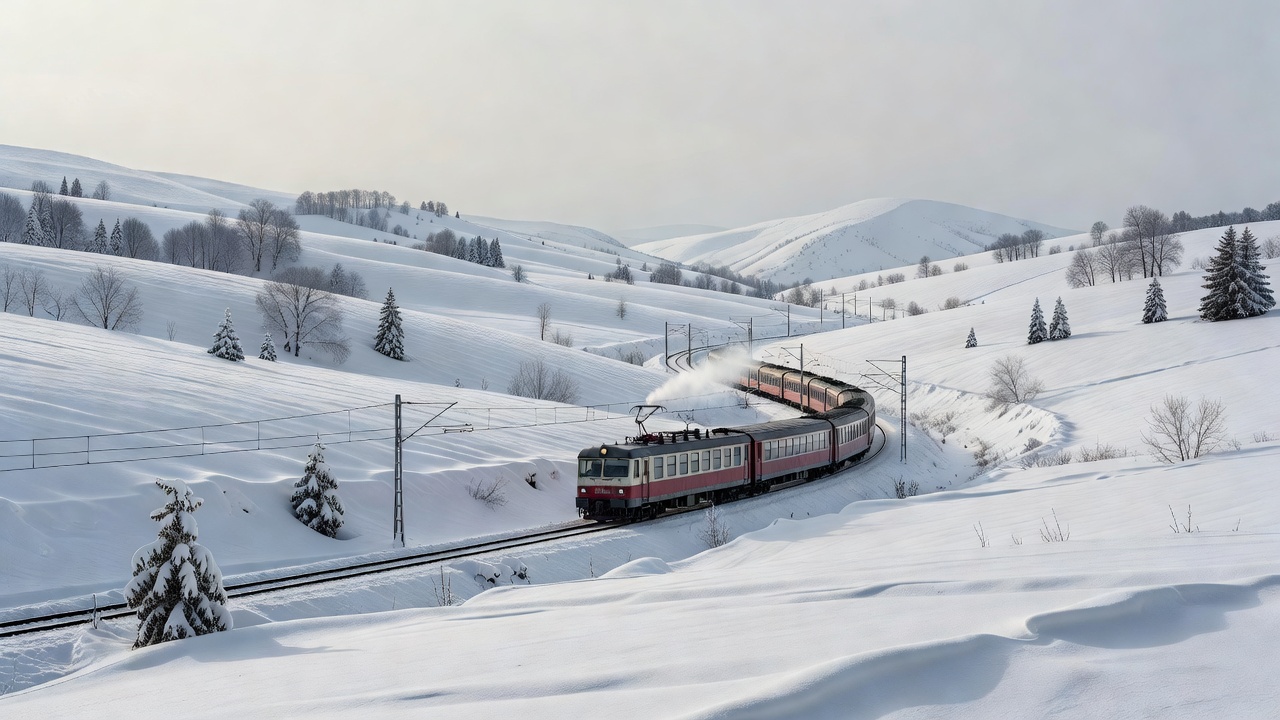
A slow line through the markets
One way to string these towns together without a car: start in Vienna, take the Railjet west to Salzburg and Innsbruck, continue to Zürich, then head to Basel and cross into France for Colmar and Strasbourg. Most legs take a few hours or less, which leaves the afternoon free and puts you in a new market square by dusk. Night trains also run between several of these countries; Austria's Nightjet network, for example, connects Vienna with German and Swiss cities.
Seat reservations for December weekends are worth making early, because trains fill with market visitors. Families with small children may prefer two nights in each town rather than one.
Season windows compared
Typical patterns only. Organisers set exact dates each year, so confirm with the town's official tourist office before booking.
| Town | Usual market window | Daylight near solstice | Rail access |
|---|---|---|---|
| Salzburg | Late November to 24 December; some smaller markets longer | About 8 h 20 min | Vienna–Munich main line |
| Innsbruck | Mid to late November into late December; some to early January | About 8 h 25 min, less in the valley shadow | Railjet Vienna–Zürich |
| Nuremberg | Friday before first Advent to 24 December | About 8 h | High-speed line from Munich |
| Gengenbach | December evenings for the town hall calendar | About 8 h 20 min | Black Forest Railway from Offenburg |
| Strasbourg | Late November to around Christmas | About 8 h 15 min | TGV from Paris; regional trains |
| Colmar | Late November to late December | About 8 h 20 min | TER from Strasbourg or Basel |
Small habits that make market evenings easier
Hot drinks at German and Austrian markets are often served in a ceramic mug with a deposit, called Pfand. Return the mug to any stall from the same market for your money back, or keep it as a souvenir. Card payment has spread, but some small stalls still prefer cash, so carry a little.
Feet get cold faster when you are standing than when you are walking, and market evenings involve a lot of standing. Wool socks and boots with a thick sole matter more than a heavy coat. With children, arriving around opening time in the late afternoon means thinner crowds and an earlier, happier bedtime. Stalls usually close sometime in the evening, and the hour varies by town and by day of the week.
For colder routes further north, continue to Tromsø, Rovaniemi and the dark-sky north.